Booking choice: The Senso-ji walking tour, from $30 per person. Check dates Tour details
Most days at Senso-ji look alike: the lantern, the incense, the crowd on Nakamise. Then a festival day comes along and the place changes completely. A golden dragon dances in front of the main hall, a hundred stalls sell lantern plants, or 100 portable shrines bounce through the streets.
This calendar runs from late October 2026 to the end of 2027. Fixed temple dates come from Senso-ji's own event calendar. Where an organiser has not announced a 2027 date yet, we say so and give the 2026 date as a guide.
The quick answer
Coming up next: the Denboin garden special viewing (30 October to 3 November 2026), the Hagoita-ichi battledore market (17 to 19 December) and New Year hatsumode (1 to 7 January 2027). The Sanja Matsuri 2027 runs 14 to 16 May. Every event at the temple is free to watch; only the Denboin garden viewing needs a ticket.
Which Senso-ji events fall between now and the end of 2027?
Fourteen dates, from the Denboin garden opening on 30 October 2026 to the Golden Dragon Dance on 18 October 2027. All are free to watch except the garden.
The temple fixes most of its ceremonies to the same day every year, so 18 March is always the Honzon Jigen-e and 9 to 10 July is always the lantern plant fair. The big outdoor events are run by other organisers and move with the weekend: Asakusa Shrine for the Sanja Matsuri, a city committee for the fireworks, a local association for the samba parade.
Busy days are busy. If your only goal is a calm look at the main hall, a festival day is the wrong day, and our guide to opening hours covers the quiet hours.
| Date | Event | Where | Cost |
|---|---|---|---|
| 30 Oct to 3 Nov 2026 | Denboin garden and Ema-do special viewing | Denboin garden | 2,300 yen in advance |
| 3 Nov 2026 | White Heron Dance; Golden Dragon Night in the garden | Temple grounds | Free (garden: ticket) |
| 17 to 19 Dec 2026 | Hagoita-ichi year-end market | Around the main hall | Free |
| 31 Dec 2026 | Year-end bell (joya no kane) | Bentenyama | Free |
| 1 to 7 Jan 2027 | Hatsumode and the New Year Grand Prayer | Main hall | Free |
| 3 Feb 2027 | Setsubun | Main hall | Free |
| 18 Mar 2027 | Honzon Jigen-e and the Golden Dragon Dance | Main hall | Free |
| 8 Apr 2027 | Hana Matsuri, the Buddha's birthday | Main hall | Free |
| 11 Apr 2027 | White Heron Dance (second Sunday of April) | Temple grounds | Free |
| 14 to 16 May 2027 | Sanja Matsuri | Asakusa Shrine and streets | Free |
| 9 to 10 Jul 2027 | Hozuki-ichi lantern plant fair | Around the main hall | Free |
| Late Jul 2027 | Sumida River Fireworks | Sumida River | Free |
| Late Aug 2027 | Asakusa Samba Carnival | Umamichi-dori | Free |
| 18 Oct 2027 | Kikukuyo-e and the Golden Dragon Dance | Main hall | Free |
What is on at Senso-ji in late October and November 2026?
The Denboin garden opens to paying visitors from 30 October to 3 November, a free projection show lights the main hall and Hozomon every evening, and 3 November brings the White Heron Dance.
The garden behind the temple office is normally closed. For five days it opens from 9:00 to 21:00, with the Ema-do hall of painted votive boards open until 16:00. Adults pay 2,300 yen in advance or 2,500 yen on the day, according to the organiser, Asakusa Culture & Lights. Every detail is in our post on the Denboin garden viewing.
On 3 November, a national holiday, the temple calendar lists the White Heron Dance (Shirasagi no Mai) in the grounds, and the garden holds a lit-up evening called Golden Dragon Night. The Golden Dragon Dance itself already took place on 18 October for the chrysanthemum service; its next outing is 18 March 2027.
When is the Hagoita-ichi battledore market in 2026?
17 to 19 December 2026, from 9:00 to 19:30 (19:00 on the last day), around the main hall.
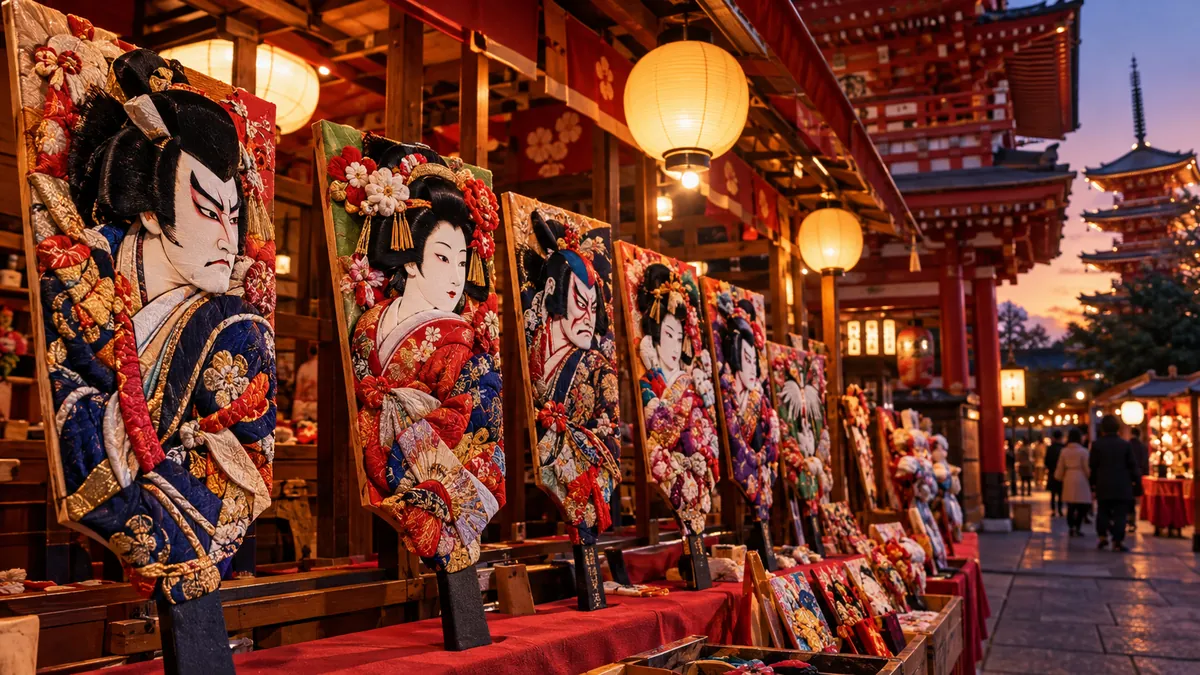
The year-end market, called toshi no ichi, has run for about 360 years, Go Tokyo says, through the 1923 earthquake and the war. Stalls sell hagoita, wooden battledores decorated with padded kabuki actors and beauties in the Edo oshi-e style, from 15 cm to 2 metres tall. People buy them as lucky charms for the new year, not as toys.
The market coincides with Osame-no-Kannon, the last Kannon fair day of the year. Go on a weekday afternoon, and bring cash for the small charms.
What happens at Senso-ji over New Year 2027?
The year-end bell rings on Bentenyama on the night of 31 December, and hatsumode, the first prayer of the year, runs from 1 to 7 January in the main hall.
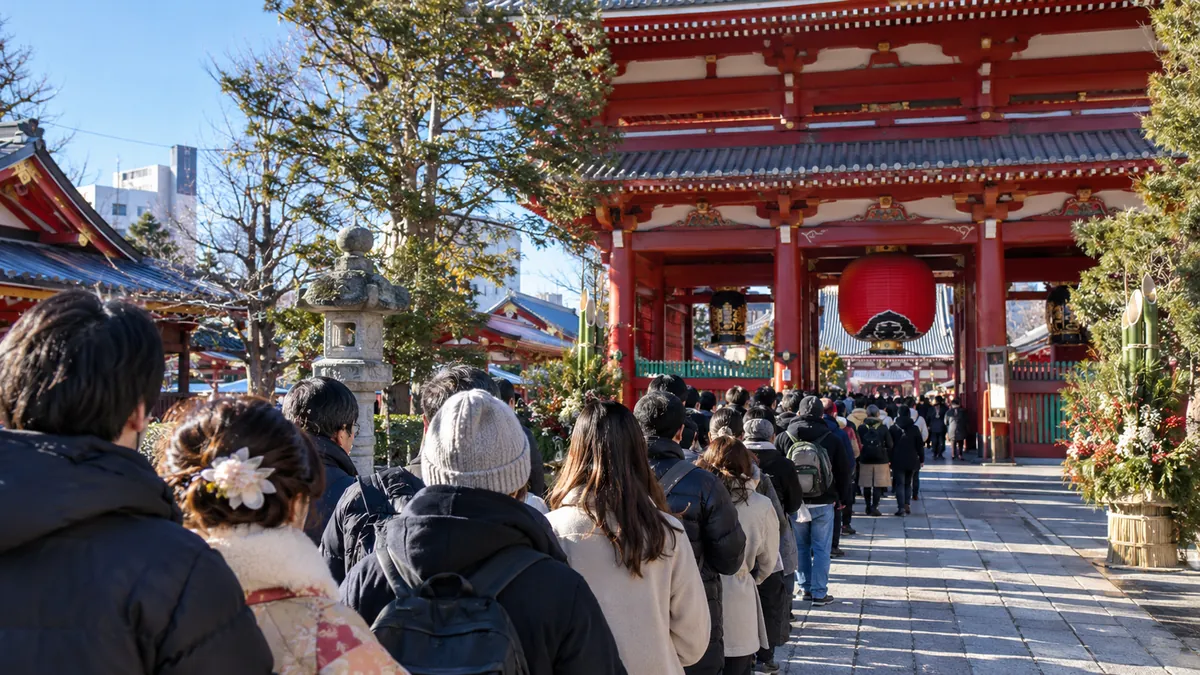
Senso-ji is one of Tokyo's biggest hatsumode spots, and 1 to 3 January bring millions of visitors. Queues from Kaminarimon to the main hall can take hours. In 2027 those three days fall on Friday to Sunday, which makes Monday 4 January the first ordinary weekday.
Hours, crowd control, charms and the quiet windows are in our New Year 2027 post.
What are the Senso-ji festivals in spring 2027?
Setsubun on 3 February, the Honzon Jigen-e with the Golden Dragon Dance on 18 March, Hana Matsuri on 8 April and the White Heron Dance on 11 April.
Setsubun marks the eve of spring, and 2027's falls on Wednesday 3 February (National Astronomical Observatory of Japan). Bean-throwing happens across Japan, but at Senso-ji the crowd does not shout "demons out". The temple explains that people call out for long life and good fortune instead.
The Honzon Jigen-e on 18 March celebrates the day in 628 when two brothers netted the Kannon statue from the Sumida River. It is the day for the Golden Dragon Dance, an 18-metre, 88-kilogram dragon created in 1958 for the rebuilt main hall.
Hana Matsuri on 8 April is the Buddha's birthday: visitors pour sweet hydrangea tea over a small Buddha statue. The White Heron Dance returns on the second Sunday of April, 11 April in 2027.
When is the Sanja Matsuri 2027, and what else is on in summer?
The Sanja Matsuri runs Friday 14 to Sunday 16 May 2027. Summer brings the Hozuki-ichi on 9 to 10 July, the Sumida River Fireworks in late July and the Samba Carnival in late August.
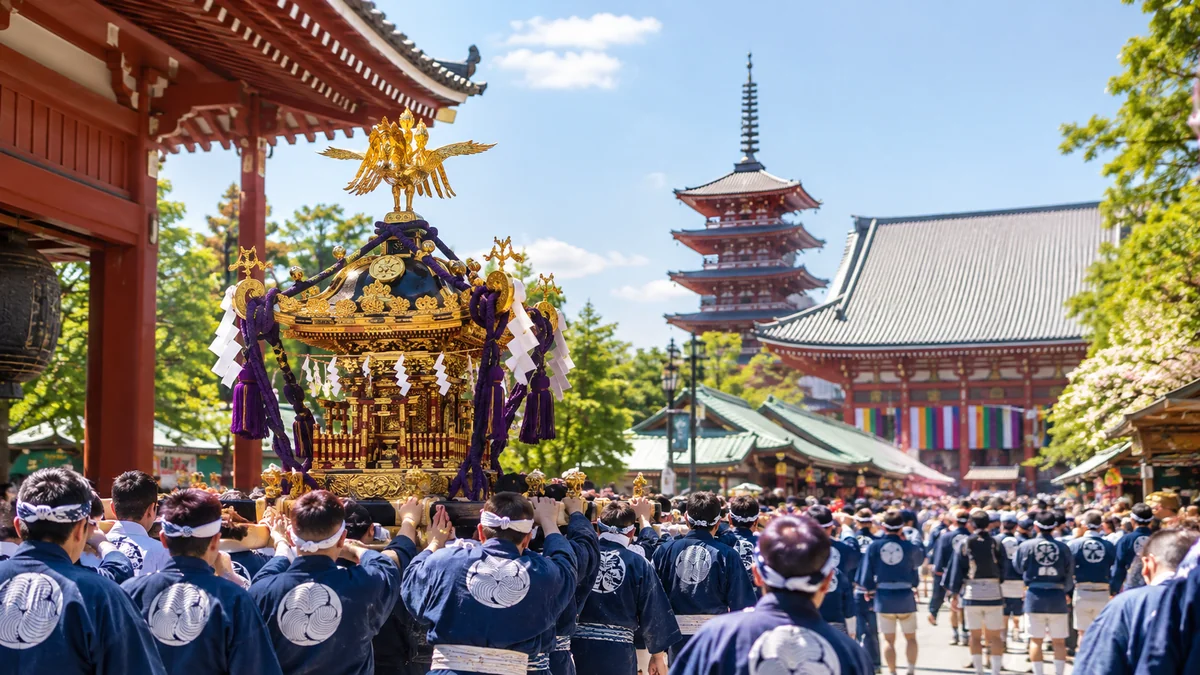
Asakusa Shrine has published the 2027 schedule: the spirit-transfer rite on Thursday 13 May at 19:00, the grand parade on Friday from 13:00, about 100 neighbourhood mikoshi from the 44 Asakusa districts on Saturday from noon, and on Sunday the three main mikoshi leave the shrine at 7:00 and return between about 19:00 and 20:00. Sunday is the crush. Saturday is the better day to watch.
The Hozuki-ichi is fixed to 9 and 10 July. In 2026 Go Tokyo listed more than 100 stalls selling potted lantern plants from 8:00 to 21:00, and a prayer on 10 July counts for 46,000 days of merit.
The Sumida River Fireworks were on Saturday 25 July in 2026. The 2027 date is not out yet; the organiser posts it on the official fireworks site. The Asakusa Samba Carnival paraded down Umamichi-dori from 13:00 on Saturday 29 August 2026, its 41st edition; Go Tokyo will list the 2027 date once it is set.
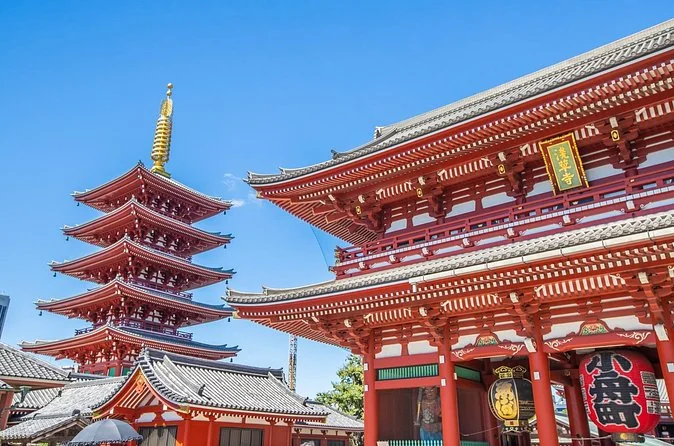
A guide explains what you are looking at, festival day or not: two hours from Kaminarimon to Asakusa Shrine, 12 people at most.
Explore the Senso-ji walking tour Tour detailsFrequently asked questions
When is the Sanja Matsuri in 2027?
Friday 14 to Sunday 16 May 2027, according to Asakusa Shrine. The three main mikoshi leave the shrine at 7:00 on Sunday and return in the evening.
Do I need a ticket for festivals at Senso-ji?
No. The grounds are free and open around the clock, festival days included. The one paid event in this calendar is the Denboin garden special viewing, 2,300 yen in advance for adults in 2026.
When is the Golden Dragon Dance at Senso-ji?
On 18 March for the Honzon Jigen-e and on 18 October for the chrysanthemum service. The next one is 18 March 2027.
What is the Hagoita-ichi?
A year-end market at Senso-ji from 17 to 19 December, selling decorated wooden battledores as lucky charms for the new year. It runs from 9:00 to 19:30, closing at 19:00 on the last day.
Ready to book
Choose your tour
Free cancellation up to 24 hours before on every option. Prices are from-prices in USD and move with the season.
Senso-ji & Old Tokyo Walking Tour
- English-speaking local guide
- Small group, 12 people at most
- Nakamise, Senso-ji, Asakusa Shrine, Hoppy Street, Azuma Bridge
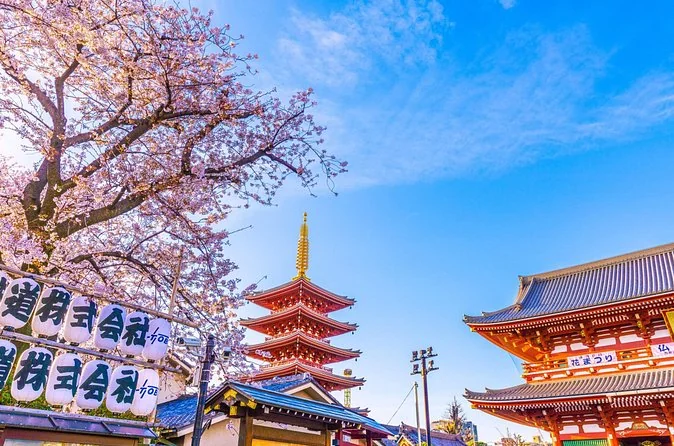
Asakusa & Senso-ji Walking Tour
The cheapest guided walk, sweets tasting on Nakamise
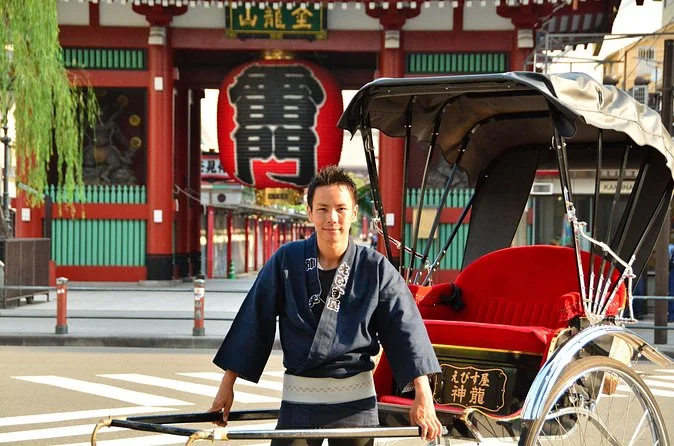
Asakusa Rickshaw Ride with a Puller-Guide
- Rickshaw ride with a puller who guides in English or Japanese
- Choice of 30, 45, 70, 90, 120 or 180 minutes
- Two adults per rickshaw; children 5 and under ride free on a lap